

Who really drives agricultural innovation?
24th March 2026Personal reflections on who really drives agricultural innovation, past and present.
Jim Orson, AFCP Trustee, started his career in the state-funded Agricultural Development and Advisory Service (ADAS) before becoming Director of the farmer-funded Morley Research Centre in Norfolk. He was then Technical Director of The Arable Group. Here Jim shares some thoughts on agricultural innovation.
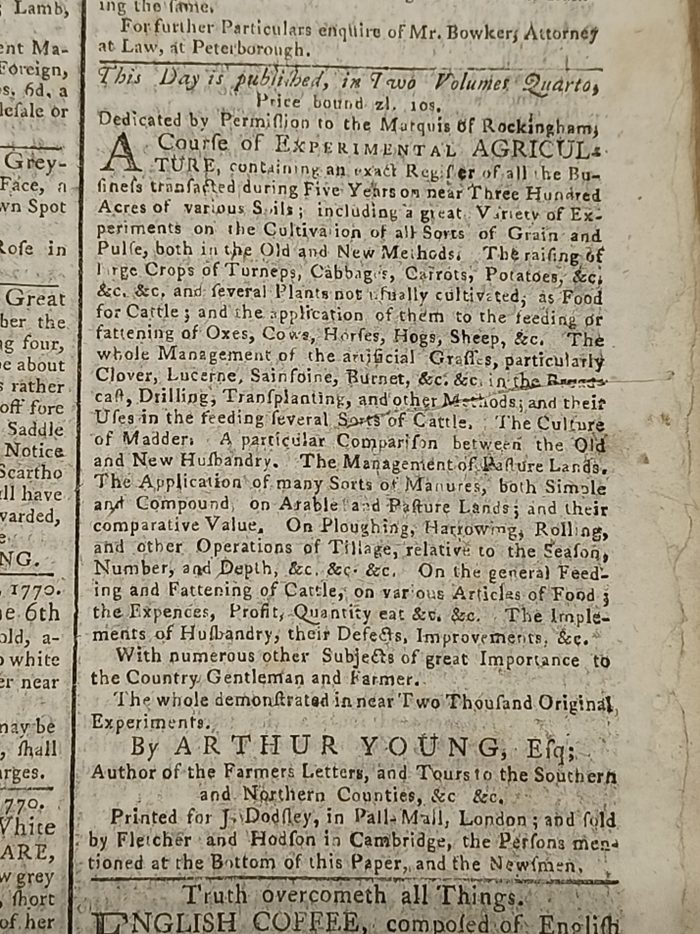
A few months ago, I was in the archives of the Cambridge Central Library reading the 6th October 1770 issue of the Cambridge Chronicle and Journal. On the front page there was an advert (see picture) publicising a new two volume book written by the greatest agricultural commentator of his day, Arthur Young. It described a total of 2,000 field experiments carried out over five years on 300 acres (120 ha.). I have not had the opportunity to read these volumes but others have suggested that Young himself was responsible for the trials. It is also suggested that they were funded, at least in part, by a major landowner, the Marquis of Rockingham. It is a matter of record that Young and Rockingham shared a mutual passion for improving agriculture. Many of the experiments had a familiar ring to them such as rotations, cultivation type and depth.
Recently, I was reminded of this advert when reading comments from students claiming that it is now the small and medium sized farms that are the innovators for new approaches in farming methods. The implication is that large farming operations are purely motivated by money and have little or no interest in playing their part in investing in the future of the industry. I really do not know why these views have formed because I know from experience that they are patently wrong.
It was inevitable that in the 1700s, said to be the start of the age of enlightenment in farming, it was the large landowners who were the innovators. Not only did they have sufficient land and funds to try new approaches but they were also better educated and had travelled more widely.
The most recognised innovators of the 1700s were Jethro Tull, Turnip Townshend and Coke of Holkham. All had large farming operations and were educated at either the University of Oxford or Cambridge.
Despite his yeoman farmer sounding name, Jethro Tull was a country gentleman. He invented the corn drill in 1701. This was because he considered that far too much precious human and animal food was being wasted in the excessively high seed rates that his workers were sowing by hand. A few years later he took to wintering in the Languedoc region of Southern France. Here he observed that inter-row cultivations in vineyards in the spring were not only an efficient method of weed control but also resulted in the vines growing more strongly. We now know this was mainly due to the extra mineralisation of soil nitrogen. Hence, his subsequent invention of a horse drawn inter-row hoe for field crops.
His inventions were adopted by Turnip Townshend, the 2nd Viscount Townshend, when he was developing the Norfolk four course rotation. For the first time in the UK, this resulted in full summer fallows not being required to keep the land in cultivation. Perhaps it is no coincidence that Turnip Townshend had previously been the Government’s Ambassador to the Hague, in the vicinity of which similar rotations had already been adopted for decades.
Close to Raynham Hall where the four-course rotation was developed is Holkham Hall on the North Norfolk coast. Here, Coke of Holkham, 1st Earl of Leicester, adopted it on his huge estate as well as implementing selective animal breeding and other new knowledge. He promoted his ideas on model farms and demonstrated them to farmers and landowners. He was the first to attempt face-to-face knowledge transfer on a large scale, including using the most successful trick in the book, free lunches. Despite this, he complained that his efforts were poorly rewarded.
Nowadays, everyone has access to education and there are far less barriers to the transfer of information. This means that, along with relatively easy to adopt trials methodology and relatively cheap measurement and analytical methods, all can try to innovate. However, it is worth noting that speakers from two very large farming operations at recent BCPC events, demonstrated that big enterprises not only share with many ‘smaller’ farmers their obsession with soil health but also their desire to innovate.
Some of the innovations that these large farming operations are evaluating/adopting involve hi-tech and require a level of capital expenditure. They can afford to invest more and, of course, their greater cropped areas mean that the potential rewards are greater. Also, large farming operations tend to be preferred partners for researchers and technology companies. Innovation in smaller enterprises tends to be more focussed on low capital approaches, some of which may, at least initially, require more intensive management.
Hence, I cannot agree with the notion, held by some, that it is the small and medium sized farms which are leading innovation in agriculture. It is simply not true and unnecessarily divisive. We are, and must remain, all in this together.